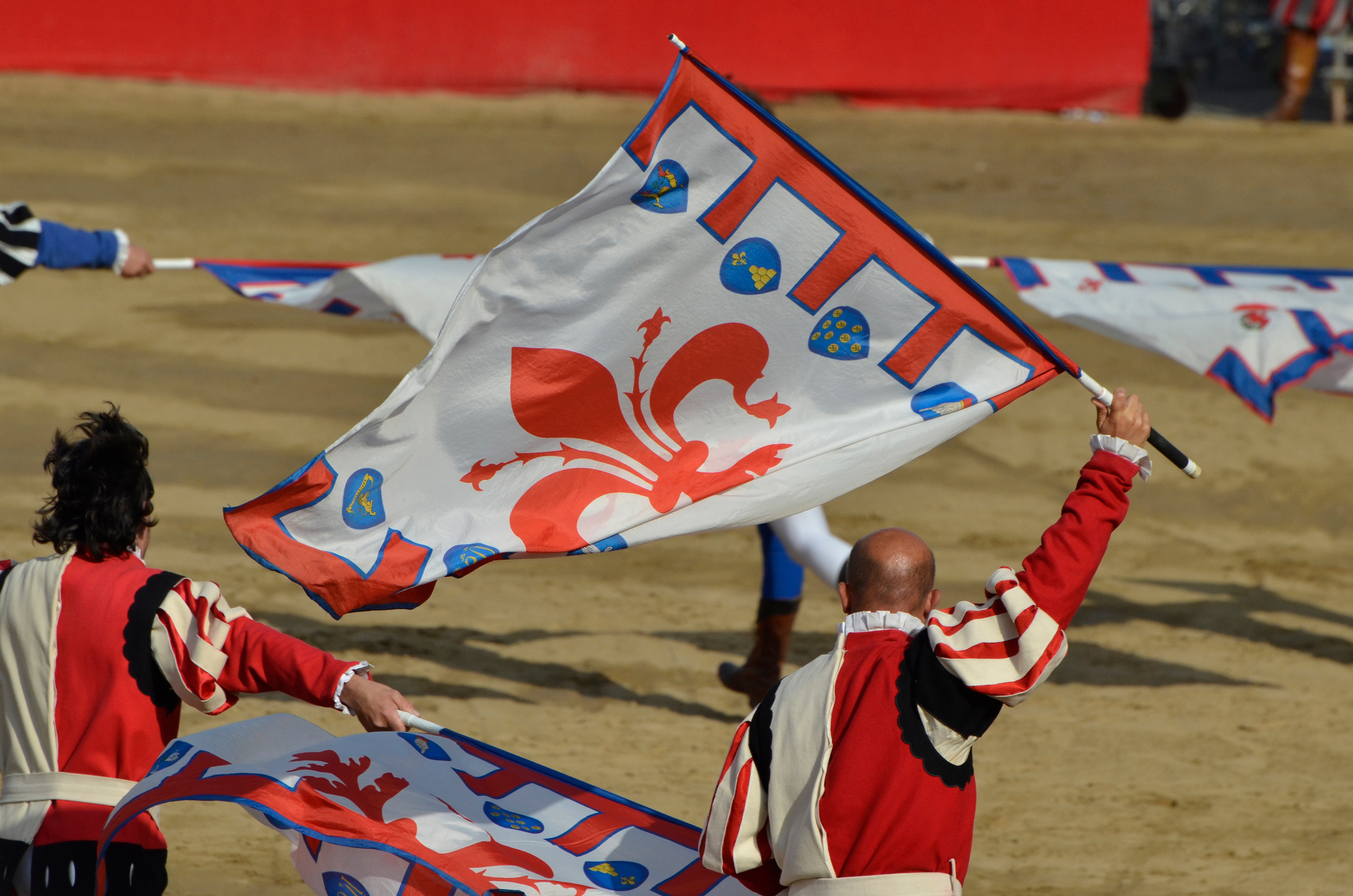
There is a Florence you won't find in the halls of the Uffizi or beneath Brunelleschi's dome. It is a city that comes alive in its squares, amid the smoke of gunpowder, the chants of the city's neighbourhoods and paper lanterns swaying through the September night. These are Florence's popular traditions: living roots, not museum relics, that every year bring centuries of history, devotion and civic spirit back to life.
Scoppio del Carro (Explosion of the Cart) — Easter Sunday
Piazza del Duomo (between Santa Maria del Fiore and the Baptistery)
On Easter morning, the heart of the city comes to a standstill for a spectacle nearly a thousand years old. A monumental painted wooden cart — the Brindellone — is pulled by flower-garlanded white oxen through the city centre and brought to rest between the Cathedral and the Baptistery of San Giovanni. The tradition dates back to the First Crusade, when Pazzino de' Pazzi brought back to Florence some stones from the Holy Sepulchre in Jerusalem, with which the Sacred Fire is still lit today.
At the Gloria during the solemn Mass, a mechanical dove sets off from the high altar, travels the full length of the nave along a taut wire and reaches the cart in the square, setting off its fireworks in broad daylight. If the dove completes the journey without a hitch, tradition holds that the year will be prosperous for the city and its harvests.
Cavalcata dei Magi (Procession of the Magi) — 6 January (Epiphany)
Piazza del Duomo and the streets of the historic centre
For Epiphany, Florence re-enacts one of the most lavish processions in art history, inspired by Benozzo Gozzoli's fresco in the Magi Chapel of Palazzo Medici Riccardi. Participants in sixteenth-century costumes, knights, pages and exotic animals wind through the streets of the historic centre in a procession celebrating the Medici family's devotion to the Three Kings. The Medici identified so closely with this cult that they founded the Company of the Magi and had themselves portrayed in the family chapel fresco.
Trofeo Marzocco (Marzocco Trophy) — 1 May
Piazza della Signoria
Every first of May, beneath the gaze of the Marzocco — the heraldic lion that symbolises Florence — Piazza della Signoria hosts one of the most elegant competitions in Italian folklore. The Trofeo Marzocco is a national contest among flag-throwing groups from across Italy: banners soar through the air in synchronised choreography to the beat of drums, in an art form that began as a medieval military communication system and evolved into a discipline of extraordinary acrobatic precision. The event is preceded by the Historic Procession of the Florentine Republic, which winds through the city centre to the square.
La Fiorita (The Flowering) — 23 May
Piazza della Signoria
On 23 May 1498, Fra Girolamo Savonarola was hanged and burned at the stake in Piazza della Signoria. Every year on that same date, the Florentines commemorate the Dominican friar with the Fiorita: a floral arrangement is laid on the cobblestones at the exact spot of his execution, marked by a small plaque. It is a quiet and moving gesture that turns the city's most famous square into a place of silent remembrance for a few hours.
Calcio Storico Fiorentino and Fochi di San Giovanni — 24 June
Piazza Santa Croce (Calcio) — the Lungarni (Fochi)
The 24th of June, feast of Saint John the Baptist, patron of the city, is the most Florentine day of the year. In Piazza Santa Croce, covered in sand for the occasion, the final of the Calcio Storico Fiorentino is played: a combat sport blending rugby, wrestling and boxing, contested between the four historic city quarters — the Whites of Santo Spirito, the Blues of Santa Croce, the Reds of Santa Maria Novella and the Greens of San Giovanni. Its origins go back to the Middle Ages; legend has it that the Florentines played it even during the siege of 1530, defiantly mocking the imperial troops of Charles V.
Every match is preceded by the spectacular Historic Procession of the Florentine Republic, with hundreds of participants in sixteenth-century dress. The evening closes with the Fochi di San Giovanni: a fireworks display that lights up the sky above the Lungarni, visible from across the city.
San Lorenzo — 10 August
Basilica and Piazza San Lorenzo
On 10 August, Florence celebrates Saint Lawrence, co-patron of the city alongside Saint John. The festivities have a warmly popular, convivial atmosphere that is quintessentially Florentine: in Piazza San Lorenzo, watermelon and lasagne are handed out to the crowds, a classical music concert is held on the basilica steps, and the Historic Procession of the Florentine Republic takes place with the offering of candles. The Basilica of San Lorenzo was the Medici family's church of choice; they are buried in the adjoining Medici Chapels.
La Rificolona — 7 September
Piazza Santissima Annunziata and processions across the city
On the evening of 7 September, on the eve of the Birth of the Virgin, Florence glows with a different kind of light. For the Rificolona, young and old alike carry colourful paper lanterns through the streets — stars, animals, geometric shapes — each lit from within by a candle. Processions set out from every neighbourhood and converge on Piazza Santissima Annunziata, where it all began: this was the site of the Fierucola, a fair that drew farmers, merchants and pilgrims from across Tuscany. Arriving at night with their makeshift lanterns, these visitors were good-naturedly mocked by the city-dwellers — the word rificolona was born as popular ribbing that gradually transformed into a shared celebration.
Carro Matto (The Mad Cart) — fourth Saturday of September
Streets of the historic centre
On the fourth Saturday of September, the Carro Matto is celebrated — one of the traditions most deeply rooted in Tuscan rural culture. A cart loaded with flasks of wine winds through the city streets in a festive atmosphere tied to the grape harvest, a rite whose roots lie in the ancient agricultural cycle of the year.
Festa della Toscana (Tuscany Day) — 30 November
Palazzo Vecchio and city institutions
On 30 November 1786, Grand Duke Peter Leopold of Habsburg-Lorraine signed the reform of the Tuscan penal code, abolishing the death penalty: the Grand Duchy of Tuscany was the first state in the world to take this step. Every year this date is marked in Florence and across the region with institutional ceremonies and cultural events, in memory of a civic achievement the city carries with pride.